
International Credit Dispute Arbitration Commission®
Founded in June 2005, the Commission is headquartered in Washington, D.C., the capital of the United States, and in Minto, New Brunswick, Canada, and provides arbitration services to people around the world.
Headquarters and services
The Commission's headquarters are in Washington, D.C. and in Minto, New Brunswick. The Commission is an arbitral institution with independent legal personality established by the World Credit Organization (WCO). It fully complies with the ICE8000 International Integrity Standard System and the ICE8000 International Credit Dispute Arbitration Standard, and resolves credit disputes by arbitration, independently, neutrally and impartially.
A credit dispute is, in general, any dispute in which one side is alleged to have breached the principle of good faith. Any dispute covered by an arbitration agreement may be submitted to the Commission, wherever the parties are located.
Arbitration follows the principles of independence, neutrality, legality, reasonableness, fairness, justice, good faith, supervision and conciliation. To facilitate supervision and reduce cost, documentary proceedings are conducted through the ICE8000 integrity management software.
History
- 19 June 2005Established in DelawareThe World Credit Organization (WCO) establishes the International Credit Dispute Arbitration Commission as an internal body of WCO.
- 3 February 2021Incorporated in Minto, CanadaWCO establishes the Commission as an independent legal entity in Minto, New Brunswick.
- January 2024Incorporated in Washington, D.C.WCO establishes the Commission as an independent non-profit legal entity in the District of Columbia.
Organization
All arbitrators directly elect nine members who form the Arbitration Commission for a three-year term. The members elect one Chair and two Vice-Chairs; the Chair presides over the Commission's day-to-day work.
Arbitrators and tribunals handle cases on behalf of the Commission under the principle of independence. Neither the members, the Commission, the Chair, the Vice-Chairs nor anyone else may interfere with the independent conduct of a case.
- The Commission decides by majority on the appointment of arbitrators and on complaints seeking their removal
- It decides and organizes the Commission's internal administration and external affairs
- It supports arbitrators in handling their cases
- Six or more members may convene a meeting; a resolution passes with the support of five or more
- Panels of arbitrators are kept by specialism, with a profile of each arbitrator
Choosing the arbitrators
Parties choose arbitrators from the Commission's panel. Where they fail to choose in time, the Chair of the Commission appoints.
Sole arbitrator
Within 15 days of the respondent receiving the notice of arbitration (10 days under the summary procedure), the parties jointly select one sole arbitrator from the panel. If they cannot agree in time, the Chair immediately appoints a sole arbitrator to constitute the tribunal.
Three-member tribunal
Within 15 days of receiving the notice, each party selects one arbitrator from the panel and both jointly select a third, who presides. If they cannot agree on the third, lots decide which party chooses; if a party fails to select in time, the Chair appoints.
Challenge and withdrawal of arbitrators
- An arbitrator who has an interest in the case must disclose it and withdraw; failure to do so results in disqualification.
- A party with justifiable doubts as to an arbitrator's impartiality or independence may request the arbitrator's withdrawal in writing, stating the facts and reasons and providing evidence.
- The request must be made in writing before the first hearing; if the ground arises or becomes known later, within two working days of that time.
- The Chair of the Commission decides on the challenge; until then the challenged arbitrator continues to act.
Basis of the tribunal's decision
The tribunal shall decide on the basis of the facts, in accordance with the universal values of humanity, the ICE8000 standards, international norms, international usage, the law of the place where the conduct occurred (or the law chosen by the parties) and the terms of the contract, following the principles of fairness and reasonableness, guided by justice and conscience, independently and impartially.ICE8000 International Credit Dispute Arbitration Standard, Article 4.42
A service mark registered in the United States
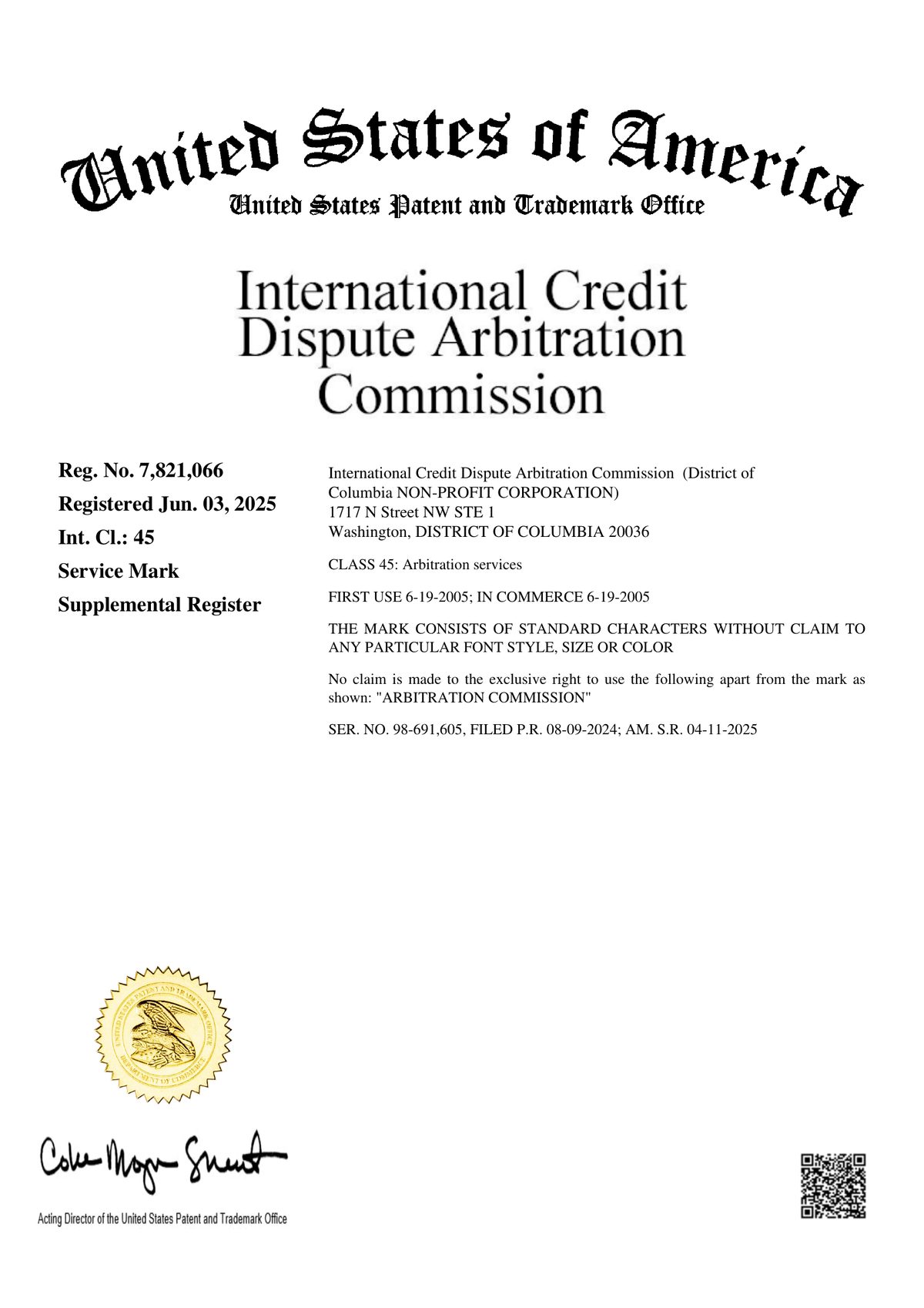
“International Credit Dispute Arbitration Commission” is registered as a service mark with the United States Patent and Trademark Office (USPTO) for arbitration services (International Class 45). The registration certificate is a public record of the USPTO and is reproduced here for the convenience of parties and the public.
- Registration No.
- 7,821,066
- Registered
- June 3, 2025
- Class
- Int. Cl. 45 — Arbitration services
- First use in commerce
- June 19, 2005
- Register
- Supplemental Register
- Owner
- International Credit Dispute Arbitration Commission (District of Columbia non-profit corporation)
Legal basis and governing law
The ICE8000 International Credit Dispute Arbitration Standard rests on the constitutional principle of freedom, the principle of public order and good morals, the principle of good faith, and the principle of freedom of contract, all recognised in the laws of most countries.
Acts performed in applying and enforcing the standard are deemed multi-party contractual acts concluded in the District of Columbia with the World Credit Organization (WCO) as certifying or supervising party, governed by and protected under the laws of the District of Columbia and United States federal law.
Three international conventions govern the recognition and enforcement of foreign arbitral awards: the Geneva Protocol on Arbitration Clauses of 1923, the Geneva Convention on the Execution of Foreign Arbitral Awards of 1927, and the New York Convention on the Recognition and Enforcement of Foreign Arbitral Awards of 1958. Parties may apply to a competent court for enforcement under them.